Thursday, May 5, 2011

Friday, April 15, 2011

FREE Web cast from Center for Watershed Protection

Greetings from the Center for Watershed Protection!
 
The  Center for Watershed Protection is pleased to announce a free webcast  scheduled
for May 4th, 2011. Attendees can now save time, travel  expenses and, perhaps most
importantly, carbon emissions, by attending  our training workshops via the Web.
 
This webcast will focus on the Wetlands-at-Risk Protection Tool (WARPT) . Join speakers
from CWP as well as guest speakers from federal and local government as  they share
their experiences and lessons learned. Dave Evans, the  Director of the Wetlands
 Division of the EPA Office of Wetlands,   Oceans, and Watersheds will also be making
a special announcement, so be  sure to tune in and learn the latest news!
~~~~~~~~~~~~~~~~~~~~~~~~~~~~~~~~~~~~~~~~~~~~~~~~~~~~~~~~~~~~~~~~~~~~~~~~~~~~~~~~
 
About the Webcast:
 
Got wetlands? Wetlands  play an important, but often unacknowledged, role in a community's
 infrastructure by providing opportunities for recreation and tourism,  storing 
floodwaters, and cleaning polluted water, among other benefits. This  webcast will
provide an overview of the Wetlands-At-Risk Protection  Tool (WARPT), a process 
for local governments that quantifies the extent  of at-risk wetlands, documents
 the benefits they provide at various  scales, and uses the results to develop a
 wetland protection plan. Case studies will cover local applications of various 
steps of the WARPT
~~~~~~~~~~~~~~~~~~~~~~~~~~~~~~~~~~~~~~~~~~~~~~~~~~~~~~~~~~~~~~~~~~~~~~~~~~~~~~~~
 
CWP'S WATERSHED & STORMWATER MANAGEMENT WEBCAST SERIES:
 
The Wetlands-At-Risk Protection Tool
 
Wednesday, May 4, 2011
Eastern: 12:00 pm - 2:00 pm       Central: 11:00 am - 1:00 pm
Mountain: 10:00 am - 12:00 pm   Pacific: 9:00 am - 11:00 am
 
Cost: Free!
 
To register click here [http://r20.rs6.net/tn.jsp?llr=soo9m4bab&et=1105145274889&s=14343&e=001fd-TB5rrt_RCiBkcSYuAJISm9io8cdyFE_t5fc0gcR6QGxMuEWmghjAao2Q37ecHwaojmDEJp86ZTDlMCE_MCVYCxsYrdvujePrcXgtHH2I40kwnK8XPFrUQrmsl2UsHg-UXwgokKXHFXqAjB5aFbpksAekoNV5cGDOTZeDxSbUbXx5i5vI4Kcvajt_fetADTs9jsZOp-10=]
Registration closes 5/02/11. Space is limited to 275, so register today to secure
your spot!
 
~~~~~~~~~~~~~~~~~~~~~~~~~~~~~~~~~~~~~~~~~~~~~~~~~~~~~~~~~~~~~~~~~~~~~~~~~~~~~~~~

Saturday, April 2, 2011

Why invite non-believers when the choir will agree with you? Bureau of Land Management forums on fracking

Please read this release. Has anyone been invited to represent "environmentalists"?
 
U.S. DEPARTMENT OF THE INTERIOR
BUREAU OF LAND MANAGEMENT NEWS RELEASE
 
Release Date: 04/01/11
Contacts: Matt Spangler รข€“ (202) 912-7414
 
 
BLM to Hold Regional Forums on Hydraulic Fracturing in Natural Gas Production
 
WASHINGTON, DC – Bureau of Land Management Director Bob Abbey today announced that the BLM will hold a series of regional public forums in late April to further discuss the use of hydraulic fracturing techniques to stimulate natural gas production on Federal lands. The sessions will be held in Bismarck, North Dakota; Little Rock, Arkansas; and Denver, Colorado. These locations will help to highlight increased regional interest in natural gas development on Federal lands and other areas where the BLM has responsibility for mineral leasing.
 
“These forums will help inform BLM as we work closely with industry, the states, other Federal agencies and the public to develop a way forward on natural gas so that the United States can safely and fully realize the benefits of this important energy resource,” Director Abbey said. “The Interior Department has a responsibility to study the potential impacts and to identify commonsense, best management practices that should be used in fracturing operations on public lands to ensure that this development is carried out in the right way and in the right places.”
 
The regional forums will build upon a forum the Department of the Interior hosted in November 2010 in Washington, D.C. on best practices for hydraulic fracturing and will provide a more in-depth, technical review of natural gas development practices on public lands. The meetings are part of the Department’s proactive efforts to ensure that oil and gas development is taking place on public lands in a responsible and environmentally sustainable manner.
 
Topics to be discussed will include best management practices, disclosure of the chemicals used in hydraulic fracturing fluids, well construction and integrity, production wastewater management and other techniques for protecting drinking water resources. Panelists will include experts from Federal and state governments, industry, and environmental organizations that have been engaged in natural gas development issues.
 
Safely harnessing the nation’s abundant natural gas resources is a vital component of America’s energy portfolio and has the potential to power the U.S. economy for decades to come and reduce dependence on foreign oil. Natural gas development on Federal lands has more than doubled over the last 20 years, from 1.2 trillion cubic feet in Fiscal Year 1991 to nearly 3.0 trillion cubic feet in Fiscal Year 2010. In Fiscal Year 2010, about 14 percent of domestically produced natural gas came from onshore public lands.
 
The BLM issues leases for natural gas development on lands managed by the BLM as well as lands managed by other Federal agencies, such as the U.S. Forest Service. The BLM also manages the subsurface mineral estate in a number of areas where the surface is privately owned. The use of hydraulic fracturing in these areas has similarly increased in recent years.
 
 
The BLM manages more land - over 245 million acres - than any other Federal agency. This land, known as the National System of Public Lands, is primarily located in 12 Western states, including Alaska. The Bureau, with a budget of about $1 billion, also administers 700 million acres of sub-surface mineral estate throughout the nation. The BLM's multiple-use mission is to sustain the health and productivity of the public lands for the use and enjoyment of present and future generations. The Bureau accomplishes this by managing such activities as outdoor recreation, livestock grazing, mineral development, and energy production, and by conserving natural, historical, cultural, and other resources on public lands.
--BLM--
 
2850 Youngfield Street Lakewood, CO 80215
 
Last updated: 04-01-2011
USA.GOV | No Fear Act | DOI | Disclaimer | About BLM | Notices | Get Adobe Reader®
Privacy Policy | FOIA | Kids Policy | Contact Us | Accessibility | Site Map | Home
 
Shawn Porter

HC 72 Box 69
Parthenon, AR 72666
870-446-6126

Thursday, March 31, 2011

Thursday, March 24, 2011

What Arkansas needs NOW!


Local Pipeline Safety Policy
http://www.pstrust.org/resources/regs/local_pol.htm

Model Setback Ordinance for Transmission Pipelines
http://www.mrsc.org/Subjects/PubSafe/pipesetbackord.aspx

Myths and Misleading Statements About Oil and Natural Gas Pipelines
http://www.pstrust.org/library/myths.htm 

Tuesday, March 15, 2011

Carbon Nation free viewing twice today at Global Campus of UA in Fayetteville, Arkansas


Peter Byck, director and producer, is coming to Fayetteville to screen his latest documentary, Carbon Nation, on Tuesday, March 15, 2011, 7:00 pm at the University of Arkansas’ Global Campus on the square in Fayetteville.   A second screening has been scheduled for 2:00 pm, same location.  Fayetteville will be among the first cities in the nation to screen this  film featuring climate change solutions.  This event is FREE and open to the public.


Click here to see a trailer of the film:  www.carbonnation.tv.     Click here to reserve your ticket:  https://secure.sceao.uark.edu/EventCalendar/default.aspx


Brought  to you by the UA Applied Sustainability Center, UA Global Campus, Osher  Lifelong Learning Institute, the Arkansas Chapter of the Sierra Club,  the League of Women Voters of Washington County, and Arkansas Interfaith  Power & Light.


Managing Director


Applied Sustainability Center


University of Arkansas


Fayetteville, AR  72701


479.575.3044 (O)   479.200.8262 (C)  www.asc.uark.edu


Make your personal sustainability pledge:  www.ecologicalcommunities.org


Set up your personal dashboard:  www.earthaid.net


Sunday, March 6, 2011

New information on antarctic from the journal SCIENCE>

 For full story and video links, please use link below:
Link to MSNBC Web site.


NASA
This satellite view shows Antarctica, which is covered by
two ice sheets divided by the Transnatarctic Mountains.
A new studyfound that a plateau justeast of the
mountain range includes ice that thaws and freezes over
time, changing the structure of the ice sheet.

By Miguel LlanosReporter
msnbc.com
updated 3/3/2011 3:15:55 PM ET
Knowing how the massive ice sheets atop
Antarctica and Greenland work is key to
predicting how global warming could raise sea
levels and flood coastal cities. But a new study
upends what scientists thought they knew. It
turns out it’s not just ancient snow that makes
up the ice sheets, but water deep under the
sheets also thaws and refreezes over time.

To put it in non-scientific terms, lead scientist
Robin Bell told msnbc.com, the study
redefines "how squishy" the base of ice sheets
can be. "This matters to how fast ice will flow
and how fast ice sheets will change."

"It also means that ice sheet models are not
correct," she said, comparing it to "trying to
figure out how a car will drive but forgetting to
add the tires. The performance will be very
different if you are driving on the rims."

Reporting in this week's issue of the peer-
reviewed journal Science, Bell and his team
described how ice-penetrating radar peeled
back two miles of ice a million years old in the
center of
Antarctica.
The images show that refrozen ice makes up
24 percent of an area known as Dome A, a
13,800-foot-high plateau roughly the size of
California. Much of the sheet and refrozen ice
lies atop an underground mountain range.

Ice from that area "drains into all the major ice
shelves of Antarctica," the researchers wrote
in their study. "Processes occurring in the
advertisement
9393750699814840266774
9393750702297840266775
'Squishy' ice shifts climate models, study says
Ice sheet structure far different than thought — complicating rising-sea scenarios
Dome A region have the potential to affect the
majority of East Antarctica."

While the field work was far inland, Bell
believes the same will hold true along the
edges of the icy continent. "We believe there is
this ice rimming the ice sheets at the edge so
this will impact how they will change," said
Bell, a geophysicist at Columbia University's

Lamont
-DohertyEarthObservatory.
The Antarctic ice sheets, some of it more than
two miles thick, holds enough fresh water to
raise ocean levels 200 feet if it all melted.
That's not expected but even if a small part did
melt it could threaten millions of coastal
dwellers worldwide.

Given already known melt in Greenland and
parts of Antarctica, the U.N. Intergovernmental
Panel on Climate Change earlier estimated
sea
levels
will rise between seven inches and two
feet this century.

Bell said the study did not look at what kind
of impact the refreezing would have. "We are
not sure if it will make them go faster or
slower," he said of ice sheets flowing into the
ocean and thus raising sea levels.

How can water be sandwiched between the ice
sheet and the continent?

"Deeply buried ice may melt because overlying
layers insulate the base, hemming in heat
created there by friction, or radiating naturally
from underlying rock," Columbia University
said in a statement along with the study.
"When the ice melts, refreezing may take place
in multiple ways ... If it collects along mountain
ridges and heads of valleys, where the ice is
thinner,
lowtemperatures penetrating from the
surface may refreeze it. In other cases, water
gets squeezed up valley walls, and changes
pressure rapidly.

"In the depths, water remains liquid even when
it is below the normal freezing point, due to
pressure exerted on it. But once moved up to
an area of less pressure, such supercooled
water can freeze almost instantly."

Ted Scambos, lead scientist at the National
Snow and Ice Data Center in Boulder, Colo.,
told msnbc.com that the finding was
"unexpected in its scope" but he also felt it
advertisement

Robin Bell
This radar image shows part of the East Antarctic ice sheet (top), a bulge of refrozen ice (center), and the profile of a mountain range buried deep below (outlined in red).
would be limited to the interior of East
Antarctica, not the more vulnerable coastlines.

"I think it is an astounding discovery," added
Scambos, who was not involved with the
study. "Who knew that a buried mountain
range would let you grow the ice sheet from
underneath?"

Bell said that "the important message" is that
while ice experts have long known of
underground water systems "greasing the
bottom of ice sheets," and thus potentially
undermining them, "we never considered that
they might be important for the actual
structure of the ice sheet."

© 2011 msnbc.com Reprints

advertisement
Quantcast

Tuesday, March 1, 2011

Dick Bennett invites all to BANJOS NOT BOMBS at 7 p.m. Wednesday, March 2, 2011 in Fayetteville, Arkansas


The Times They Are A'changin.  How fast?  Take a look at this "exponential tmes" video from Sony Corp. If you can't get it well here, check out the YouTube link here.

Fuel OMNI
Your Support Helps OMNI Grow!
Thank you deeply!

Keep Up With OMNI
Email:

The OMNI Center for Peace, Justice, and Ecology announces

Banjos Not Bombs - Wed March 2

7:00 pm - Uark Ballroom Dickson Street Fayetteville
Features Roy Zimmerman - terrific political satirist - and a host of music greats!
 

You can help us beat the Guiness Book of World Records for

MOST BANJOS ON STAGE AT ONE TIME PLAYING A PROTEST SONG!

Bring your banjo and get in for $5.00!
No banjo?  Cut one outta cardboard and come on down 
  For more information call Kelly at 582-2291.
 =========== + ============

Check out the new Youth Program Web pages

We've been working long and hard to make them amazing. 
We still have a long way to go, but many of them are up and viewable right now!
Learn more about how the OMNI Center is empowering and inspiring youth!

Thursday, January 20, 2011

Friday, January 7, 2011

Please speak up now: Full disclosure of chemicals used in fracking is open for comment to the Arkansas Oil and Gas Commission

To those interested in the natural gas development in Arkansas:

Pittsburgh stands first in the country to have banned the fracking process from their city.  Attending the rally before the vote was Josh Fox giving a spirited speech.  I thought you would be interested to hear the passion he displays even after the long involvement he has had with this project.

Update on Arkansas activity:

Arkansas Oil and Gas Commission - 

Jan. 10th is the cutoff date to make comment requesting full disclosure of all fracking chemicals by CAS identification.  While there have been improvements made to the Oil & Gas Commissions rule on disclosure, it is incomplete by failing to incorporate the Federal standards for proprietary secrecy.  A simple request that they finish to the job of disclosing chemicals for public safety and land owner consideration is in order.  Request that all comments be extended to the commissioners as well.  Use the following information to make comment:

Copy to:  Commissioners - Chad White, Chairman, W. Frank Morledge, Charles Wohlford, Bill Poynter, Mike Davis, Kenneth Williams, William L. Dawkins, Jr., Jerry Langley, and Chris Weiser

Mr. Lawrence C. Bengal, Director
Production and Conservation
Arkansas Oil and Gas Commission
301 Natural Resources Drive, Suite 102
Little Rock, Arkansas 72205

Subject:  Full disclosure of chemical constituents used in natural gas fracking

Issue:  The current B-19 ruling is incomplete in providing limited claims for proprietary formulas.  The best approach would be full disclosure of every constituent by CAS identification, but at minimum the Federal guidelines for trade secrets should be included in the rule in their entirety.  The current wording is incomplete and does not provide how secrecy would be granted or what percentage would be allowed.

Thank you for assisting with this important comment, if you are able to help.  Pass the word.

Monday, December 27, 2010

Ambrosia trifida feeds many birds in September and October and a few persistent ground-scratchers all winter

Please click on individual images to ENLARGE view of immature and adult male cardinals feeding on Ambrosia trifida in September 2010.
September and October are feasting months for locally fledged birds as well as the hoards of migrating birds that find Ambrosia trifida a special native treat in Fayetteville, Arkansas. The importance of allowing native plants to go to seed and remain standing as "feeders with legs" cannot be overemphasized.


Saturday, December 18, 2010

Jim Bemis speaks at Telecom Board meeting on December 16, 2010


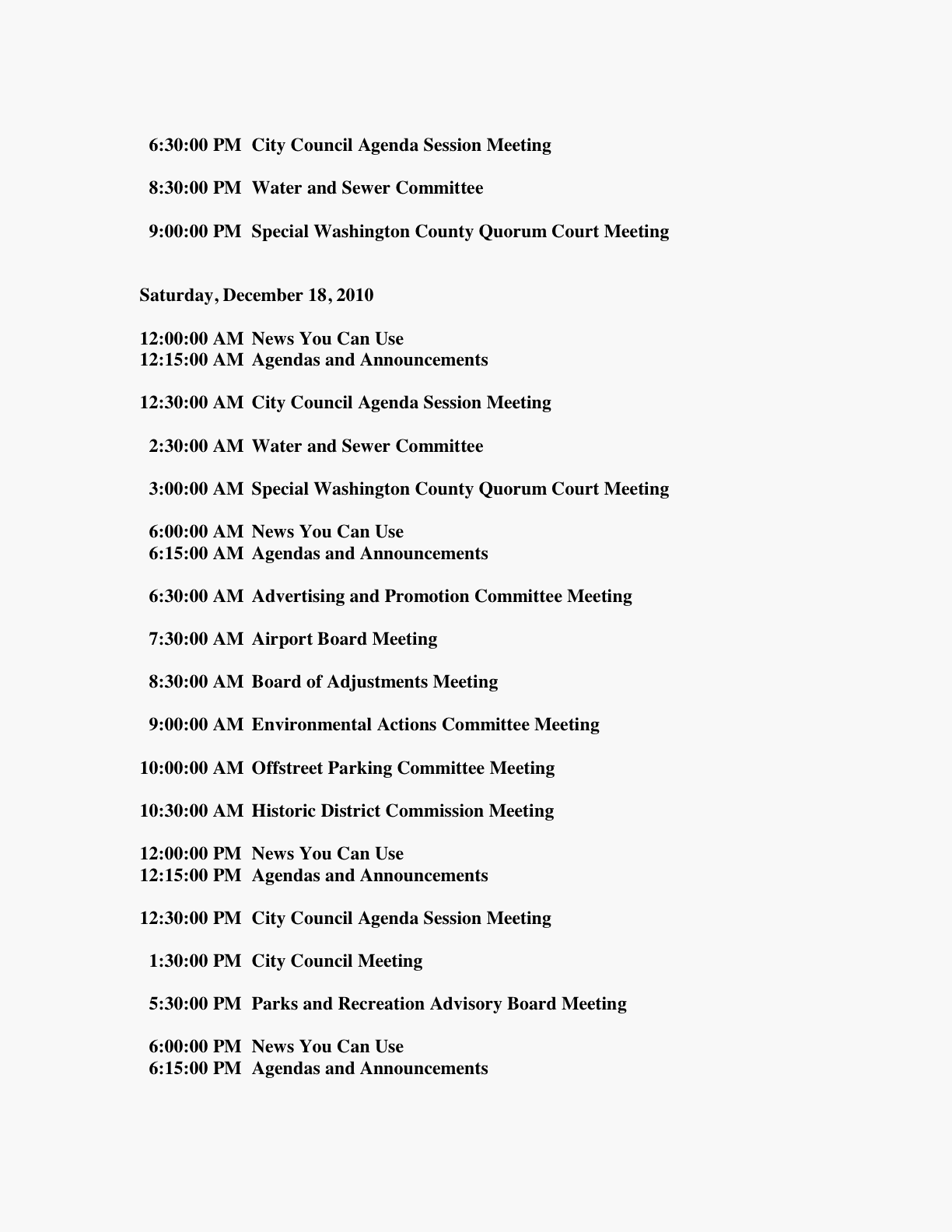
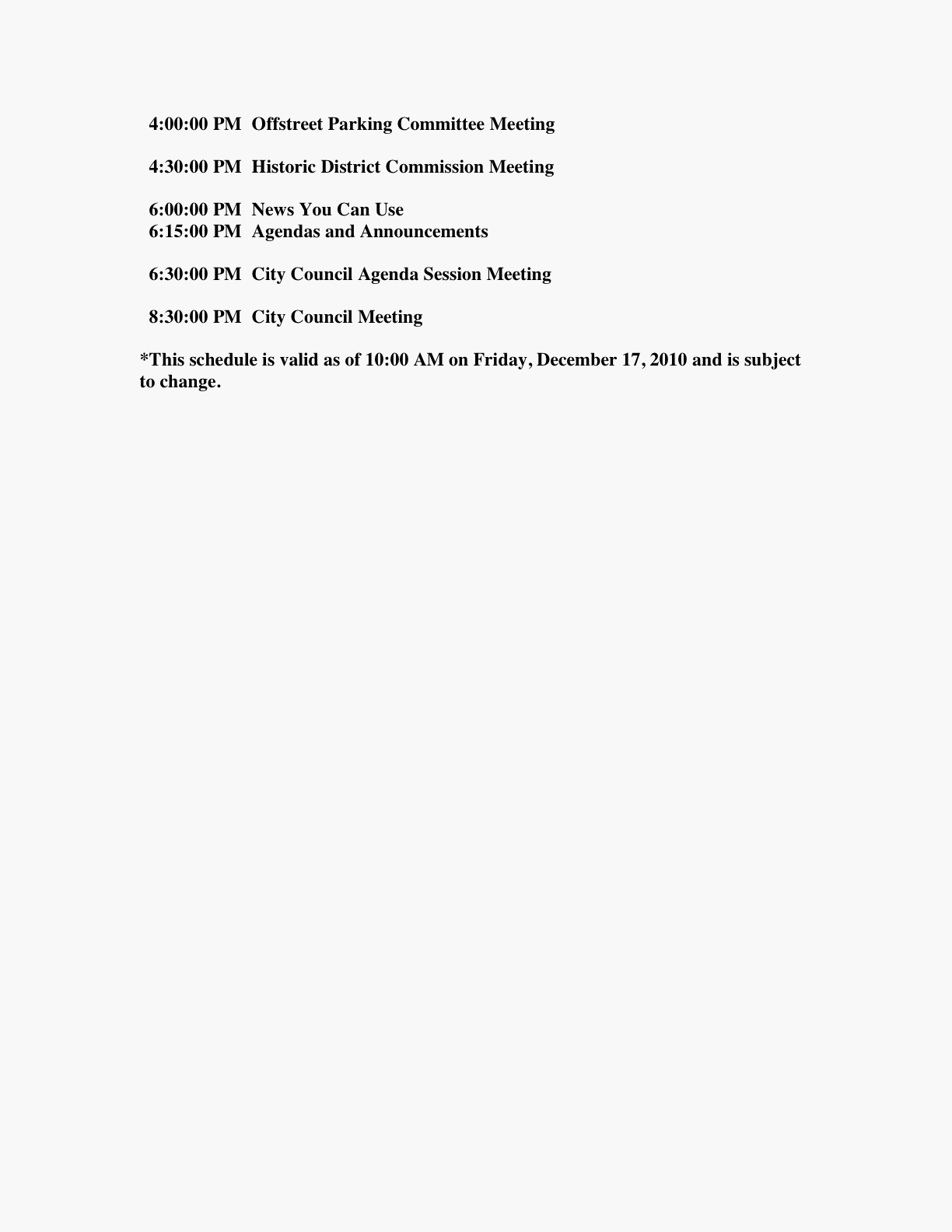
GOVERNMENT CHANNEL SCHEDULE published Friday, December 17, 2010, the day following Telecom Board meeting, does not include Telecom Board meeting video to be run during week of 12/17/2010 through 12/12/2010. Bemis' comments, therefore, will not be shown on Cox Cable or AT&T U-verse until long after the Fayetteville City Council meeting at which the CAT contract will be voted on Tuesday, December 21, 2010.
Please click on individual pages to ENLARGE for easy reading.